
Stop Watching the Hurricane Forecast - even with El Nino
Commodity Report #258


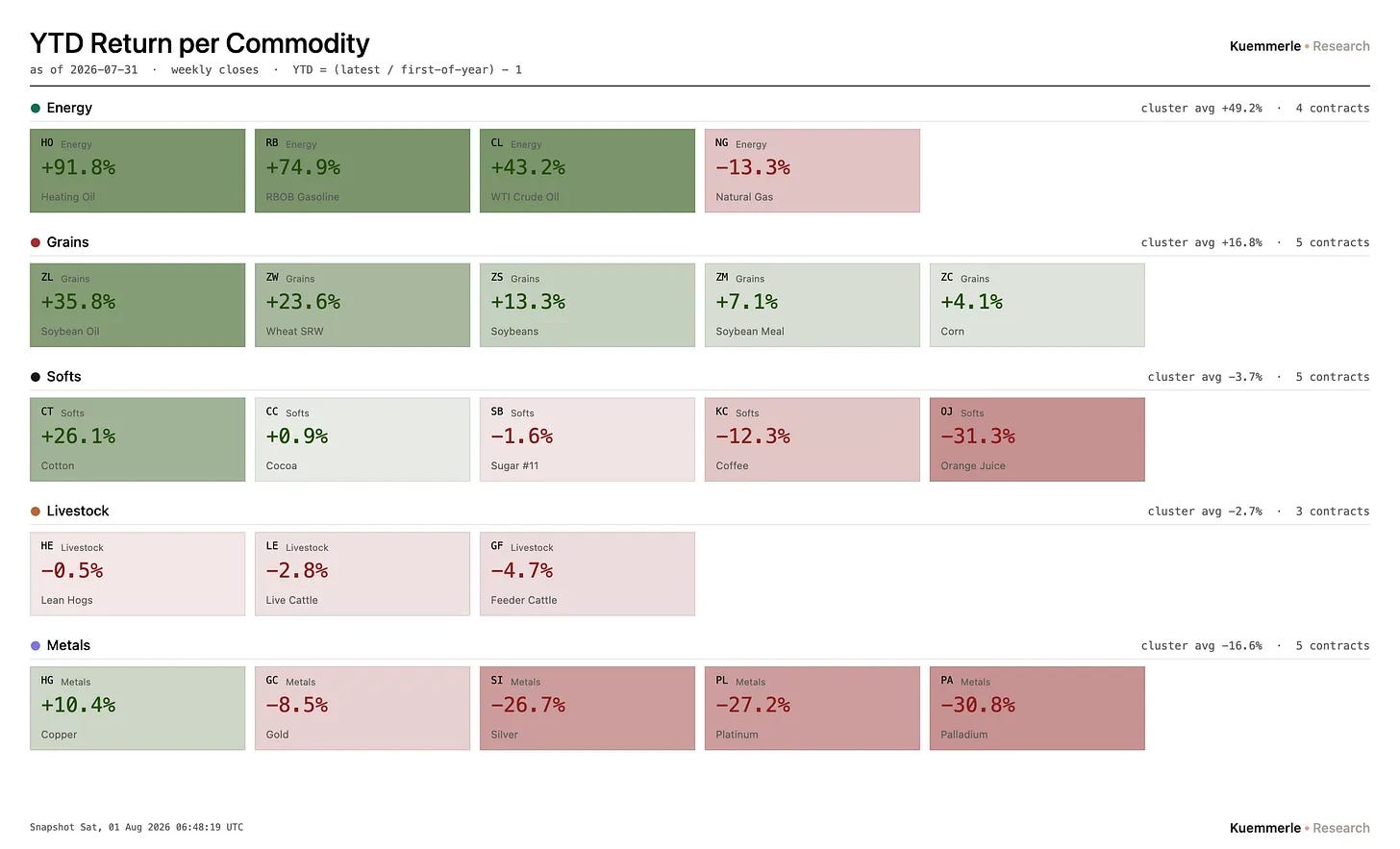
*YTD our absolute return strategy is up +4.7%
Find our 2025 performance here (+20% total return and 2.99 Sharpe)
As the US hurricane season enters its most active phase, investors are once again turning their attention to catastrophe bonds.
After all, the asset class has delivered an unprecedented run of performance, with the Swiss Re Global Cat Bond Index returning 19.7% in 2023, 17.3% in 2024 and 11.4% in 2025. Record issuance has followed, with $17.6bn of new cat bonds coming to market in the first half of 2026 alone.
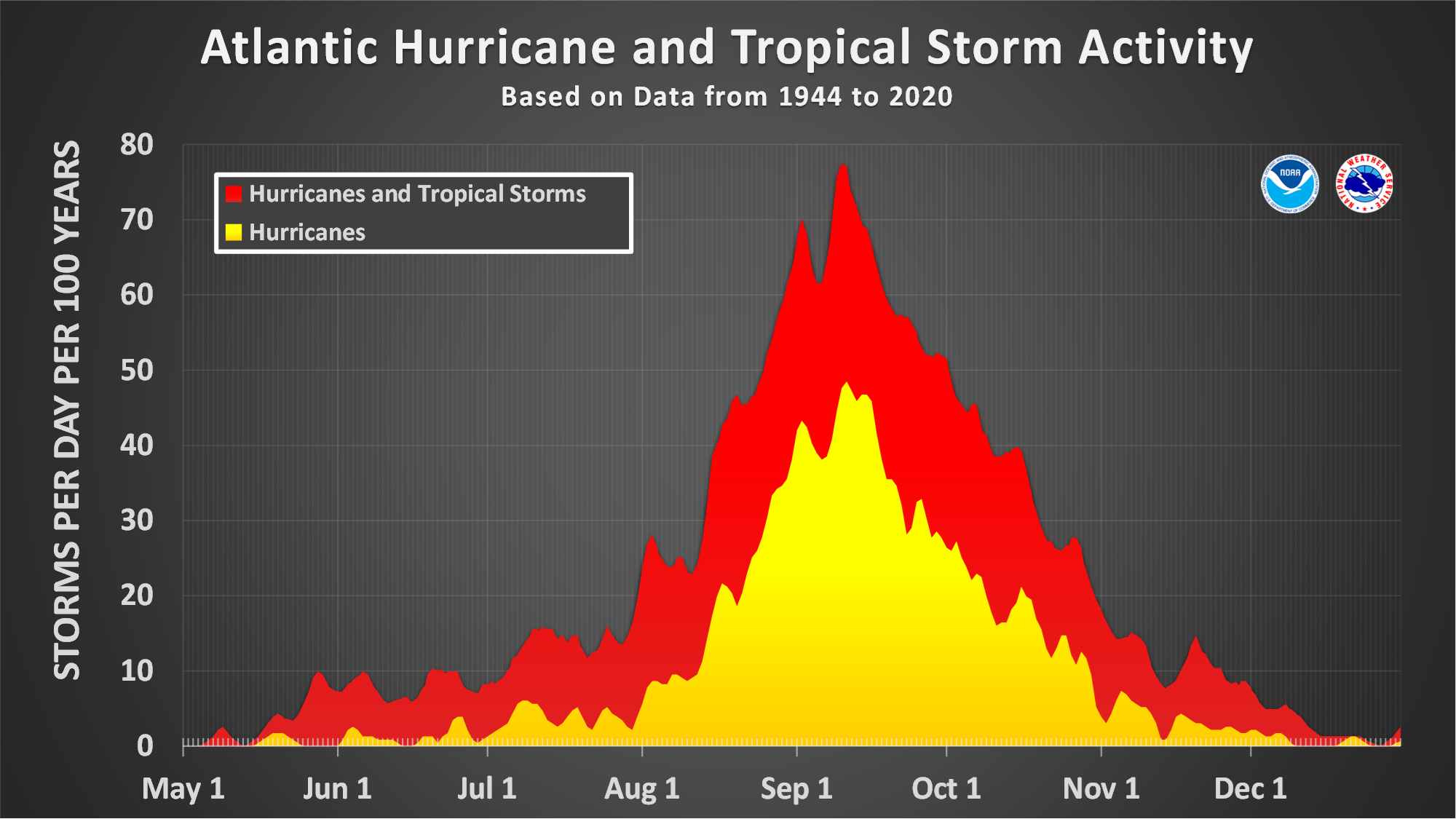
It is tempting to assume that this year’s climate backdrop offers clues about what comes next. Colorado State University’s latest hurricane outlook points to a strengthening El Niño. The weather pattern typically suppresses Atlantic hurricane activity. A quieter season should be good news for cat bond investors – or so conventional wisdom suggests.
However, the relationship appears far weaker than many expect.
An analysis of 75 years of NOAA hurricane data, combined with multiple climate indicators, confirms that El Niño and La Niña remain reliable predictors of hurricane activity. El Niño reduces Atlantic storm formation, while La Niña tends to increase it. Combined with tropical Atlantic sea surface temperatures, the two factors explain as much as 35% of the variation in major hurricane counts.
The problem is that fewer hurricanes do not necessarily translate into stronger cat bond returns.
Comparing historical cat bond loss years with prevailing climate regimes shows little evidence that seasonal weather patterns can distinguish profitable years from loss-making ones. Even Colorado State’s widely followed seasonal forecasts – including its landfall probability estimates – fail to identify years in which investors ultimately suffered losses.
History offers several examples. The powerful El Niño of 2015 coincided with a negative year for cat bonds, while 2010 delivered an exceptionally active Atlantic season and elevated landfall probabilities, yet investors still generated positive returns.
The explanation lies in how catastrophe bonds are structured. Returns are driven less by the number of storms in a season than by whether a particular hurricane strikes an insured region and breaches the specific trigger conditions written into an individual bond. A relatively quiet season featuring one destructive landfall can produce greater losses than an active season in which storms remain over open water.
Instead, the biggest drivers of expected returns are considerably more straightforward.
The Swiss Re Global Cat Bond Index consists of two components: coupon income, derived from collateral yields and insurance risk spreads, and price returns, where catastrophe losses are reflected. Historical analysis suggests short-term interest rates alone explain roughly a quarter of annual return variation, with cat bond performance moving broadly in line with changes in three-month US Treasury bill yields. Adding climate variables to the model provides almost no additional explanatory power.
That points investors towards a simpler framework.
Three-month US Treasury bills currently yield around 4%, while cat bond risk spreads have normalised to approximately 6% following the post-Hurricane Ian repricing. Together, these imply an expected return of roughly 10% for 2026 before accounting for any catastrophe losses.
Historical performance broadly supports that assumption. Cat bonds have produced positive annual returns in 21 of the past 22 years, with coupon income providing a meaningful cushion against all but the most severe catastrophe events. (sorry here for missing a few years but hadn’t all the datapoints when making these charts on a Sunday evening, but you surely get the idea)
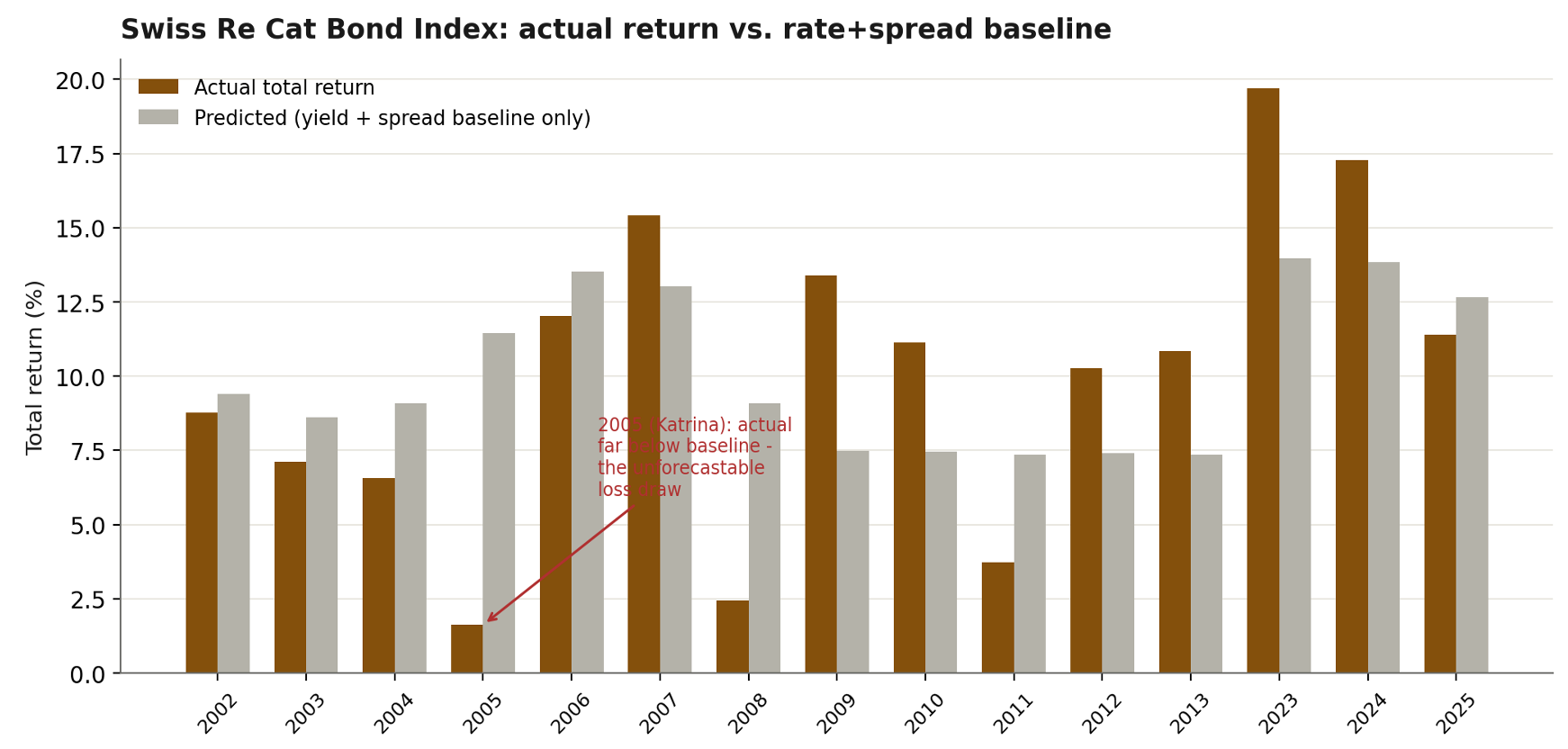
That does not eliminate downside risk. Major events such as Hurricane Katrina in 2005 resulted in returns that fell sharply below what prevailing interest rates alone would have suggested. Crucially, none of the seasonal hurricane forecasts examined would have anticipated those outcomes.
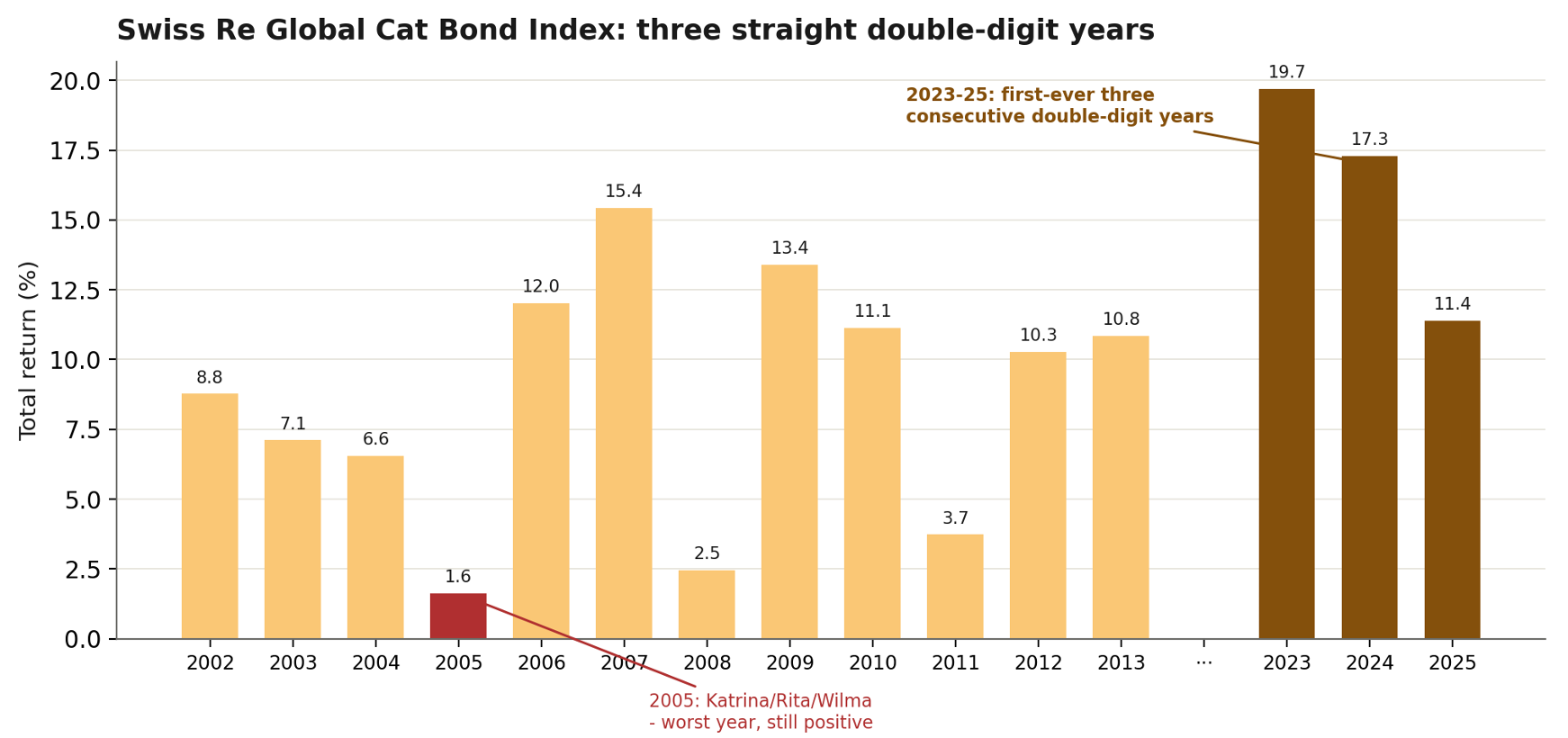
Seasonal hurricane forecasts remain valuable tools for meteorologists, but they offer little predictive value for cat bond performance. Those seeking to assess expected returns should pay closer attention to interest rates and insurance risk spreads than to forecasts of Atlantic storm activity.
Ultimately, the tail risk embedded in catastrophe bonds stems not from how many hurricanes form in a given season, but from whether a single storm strikes the wrong place at the wrong time. Either the strength of El Nino or La Nina wont help you with that assesment.
Have a good start into the week,
Lukas
Institutional Services
If you’re an institutional investor that wants to commit money into our strategy, receive a portfolio-overlay or copy our strategy to participate directly from our framework - contact us via info@lukas-kuemmerle.com
Till next Monday, Lukas
If you have any questions in the meantime, please feel free to contact me via X or Mail.